Wednesday, 5 December 2012

A proposal for a global ban on trans fats

While labeling strategies provide a sound public policy response to some food ingredient dilemmas, in other cases it is simpler and more effective to make do without the ingredient altogether.  Some argue that trans fats fall into the category of ingredients that should just be eliminated (with the exception of the small amount of trans fat that occurs naturally in animal food products).  These fats replaced healthier traditional oils and fats just a few decades ago, and some countries have recently been rapidly shifting back away from their use without any major food system damage.

In a commentary this week for the World Public Health Nutrition Association, Vivica Kraak, Uriyoán Colón-Ramos, and Rafael Monge-Rojas recommend a near-complete global ban on trans fats.
This commentary presents a case for public health professionals, practitioners, academics, industry and government representatives, funders, public-interest non-governmental organisations and consumer advocates, to collaborate to support a global trans-fat ban. Coordinated actions to remove this harmful substance from our food and eating environments will be able to contribute to reducing chronic non-communicable disease mortality by 2025.

New book: US Programs Affecting Food and Agricultural Marketing

The new book edited by Walter Armbruster and Ronald Knutson is titled: US Programs Affecting Food and Agricultural Marketing (published by Springer).  I have ordered it from my university library and look forward to reading it.  It includes many chapter authors whose work is covered here from time to time.  A theme appears to be that food policies may need to change over time, just as the private sector markets have been undergoing dramatic transformations over the years.


Tuesday, 4 December 2012

New USDA organic agriculture survey

USDA in October released results from its 2011 survey of certified organic production.  Previously, the most recent such statistics came from a 2008 survey. 

The National Sustainable Agriculture Coalition explains how the survey results could be used to make crop insurance more accessible to organic producers.  Carolyn Dimitri, who used to do economic research on organic agriculture for USDA, and who now teaches and blogs at New York University, summarizes the differences in methods and results from 2008 to 2011.
The one sweeping generalization that I quickly reached is that the number of certified farms with sales declined between 2008 and 2011 for most, but not all of the commodity categories. At the same time, the value of sales increased for most categories, even for those with a decline in the number of farms. Several possible explanations come to mind: (1) farms exited the organic industry after 2008 because of the recession; (2) farms grew larger in terms of acres, which I can check (but haven’t yet); (3) the value of farm sales increased because prices farmers were paid increased, or because they were more productive, or a combination.

Monday, 3 December 2012

VILSACK PRAYS - PATEL: USDA & US GOV'T FOOD OASIS "A MIRAGE"

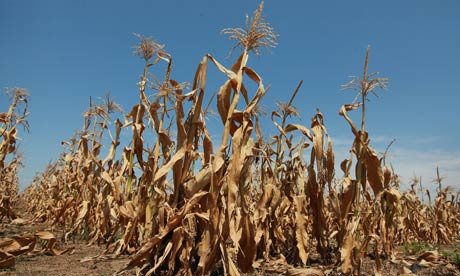
Severe Midwest Drought ContinuesUS politicians must regulate finance to tackle the drought and food-price crisis

US leaders worked hard to tackle the 1930s drought and food crisis. Today they are supine, offering the hungry only prayers

Corn plants on a drought-stricken farm near Oakton, Indiana. The corn and soybean belt in the middle of the nation is experiencing one of the worst droughts in more than five decades. Photograph: Scott Olson/Getty Images
If you're wondering whether the US drought will create a global food crisis, the answer's easy. It's yes, because there's a food crisis already. The latest year for which we have figures is 2010, when 925 million people were declared malnourished. Soon after the number was announced, the World Bank corrected it upward, and recently said that the number of hungry people is "almost 1 billion".
Make no mistake: the US drought is fierce. In June this year, out of a possible 171,442 temperature records, 2,284 were broken and 998 were tied. The London Olympic Games should be so lucky. The drought isn't merely bad because the crops are parched. Climate change has nudged the temperature more than a degree higher than the previous record-breaking US drought in the 1950s. The heat is killing natural systems, and making recovery far harder. We don't yet know what the final reckoning will be for food prices. Corn hit a record $8 a bushel on Monday (in September 2006, the price was nearer $2 a bushel). The price is driven by a demand for animal feed, high-fructose corn syrup, and an incredibly stupid US biofuels policy that mandates the transformation of food into ethanol. With the US producing over half of world corn exports, and with the price of those exports set by domestic uses of corn, the US drought will have a profound impact on prices.
Other grains aren't having a great year either. The US is a major soy exporter, and prices have soared over the past few days. Nor is America the only place to suffer extreme weather. This year, a late monsoon in India, and an ongoing southern European heatwave, add to the uncertainty about harvests and crops.
Uncertainty is profitable. The Food and Agriculture Organisation is worried about price swings, even though prices are far from their 2011 peaks. Volatile prices create markets for hedge funds to trade and gamble on future trends. Traders, enabled by lax futures regulations, are perhaps the only people to see the bright side of the beating sun.
Which is why it's worth looking to history. Record-breaking weather, farmers losing crops, banks repossessing land from the poor, a president scorned by his opponents for socialism. We've seen this before. Such were the conditions of the dust bowl in the 1930s. Then, the drought stretched across most of the decade. By 1938, 80% of the Great Plains had been damaged by wind erosion. In large part, it was because farmers on small farms weren't taking care of the soil. What would bring farmers to the point of destroying the soil on which they depended? Most of them were deeply indebted to banks, and hanging on by their fingernails. Environmental destruction staved off financial oblivion.
In response, the Soil Conservation Service was created to help farmers directly. But farmers' financial crises needed more than tree-planting. The dust bowl was also tackled with changes in the banking system, regulation to stop foreclosure, stabilisation policies to stop wild swings in prices, and even, as part of the New Deal, employment in the Worlds Progress Administration to help the former family farmers cast off their land for ever.
These policies didn't come easily. They were the fruits of widespread organising, from the work of socialist leagues to the populism of Huey Long. All of this is worth recording, because in the wake of the 2008 food price crisis, so little has changed. The US government hasn't sufficient grain in its reserves to stabilise prices. Public grain reserves were shrugged off in the 1990s as inefficient. No sense in having mountains of grain when, in a pinch, the market could be counted on to provide. Perish the thought that governments might intervene in the banking sector, or engage in public works programmes so that the hungry, 60% of whom are women or girls, might afford to eat.
Instead, the US secretary of agriculture, Tom Vilsack, has this to offer: "I get on my knees every day, and I'm saying an extra prayer now. If I had a rain prayer or a rain dance I could do, I would do it." So politicians, parched of ideas, are supine. They chant mantras about the sparkle of the agricultural and financial innovation that will, soon, provide relief. But the heat is strong and the sun is high. Their oasis is a mirage.
www.generationfoodproject.org
Source:  http://www.guardian.co.uk/commentisfree/2012/jul/24/us-politicians-regulate-finance-drought-food

Pork alliance removes National Pork Board from Alliance Partners list

U.S. Food Policy reported on Wednesday that the National Pork Board (a federal checkoff program) was listed as an Alliance Partner on the website of the Pork Alliance, a lobbying entity sponsored by the National Pork Producers Council (a private-sector trade association).

It is against the law for federal checkoff funds to be used for lobbying.

I see today that the Pork Alliance website no longer lists the National Pork Board.  The alliance must have removed the board from the list in the past 3 days, after a complaint was filed by the Humane Society of the United States.

Here, for the historical record, is my screen capture from last Wednesday (click the image for a higher-resolution view).  The National Pork Board appears right below Merck Animal Health.


The carbon footprint of food

Recently, I was in the market for a good layperson's summary of the environmental impact of food choices.  The one I liked best so far was the brief chapter on food late in the book How Bad Are Bananas?: The Carbon Footprint of Everything, by Mike Berners-Lee.

Berners-Lee takes measurement seriously.  At the same time, he is completely frank about how rough some measurements are.  He doesn't waste time figuring out every last significant digit.  Instead, he stays focused on the information that really matters for making sensible lifestyle choices.

Berners-Lee has a talent for explaining technical material.  As just one simple example, he has a delightfully clear explanation of a financial discount rate, an important concept for evaluating payback periods for investments (p. 188).  Other authors might be tempted to skip the topic, but Berners-Lee recognizes that the layreader can understand this issue, without needing any equations.

From the food chapter, here is a summary food tips:
  • Eat what you buy. 
  • Reduce meat and dairy.
  • Go seasonal, avoiding hothouses and air freight.
  • Avoid low-yield varieties.
  • Avoid excessive packaging.
  • Help the store reduce waste.
  • Buy misshapen fruit and vegetables.
  • Lower-carbon cooking. 


    On related issues, I enjoyed seeing a presentation at the Friedman School's Wednesday seminar series last week by Susanne Freidberg from Dartmouth College, who spoke about Life Cycle Analysis (LCA).  Her most recent book is Fresh: A Perishable History.

    Among other topics, Freidberg described the use of LCA in corporate sustainability initiatives, of which a leading example is Walmart's.  Although a major retailer won't say "reduce meat and dairy" or "avoid excessive packaging," I nonetheless find the Walmart initiative interesting.  Just for example, this video is blunt: "The raw truth is that the design of this system is unsustainable."  And it provides a nice visual explanation of a food product's life cycle.


    December issue of the Friedman Sprout

    The December issue of the Friedman School's graduate student publication, the Friedman Sprout, came out today.  It includes articles on the local Slow Food chapter, how to survive a New England winter, craft ideas, and book reviews.  I was interviewed for an article on the Prop 37 vote in California over GMO foods.