Saturday, 15 September 2012

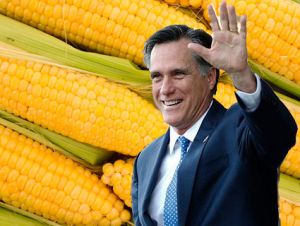
FRANKENPRESIDENT ROMNEY WOULD BE DEAR OLD FRIEND TO GMO'S IN A VERY HIGH PLACE


How Mitt Romney Helped Monsanto Take Over the World
 —By
| Fri Sep. 14, 2012 3:00 AM PDT 
Today, Monsanto looms over the global ag landscape like a colossus. It is the globe's largest seed purveyor—and its dominant vendor of genetically modified traits. How dominant? Here's NPR on the company's mastery over the US GMO market: "More than 9 out of 10 soybean seeds carry [Monsanto's] Roundup Ready trait. It's about the same for cotton and just a little lower for corn." It also sells nearly $1 billion worth of herbicides every three months.
But for all its clout, Monsanto is a relatively new player in the Big Ag game. While fellow ag giants like ADM, Cargill, Bunge, and BASF have been in the game for a century or more, as recently as the late 1970s Monsanto was known mostly as a chemical company; herbicides were a relatively small sideline, and genetically modified seeds were just the gleam in the eye of a few scientists in the R&D department. And its flagship chemical business had plunged into crisis. In 1976, Congress banned the highly toxic industrial coolant PCB—the US production of which Monsanto had enjoyed what the Washington Post called a "lucrative four-decade monopoly." According to the Post, Monsanto had been actively covering up the dangers of PCB exposure for years before the ban, opening the company to a thicket of lawsuits. To make matters worse, the company had also been heavily invested in the toxic pesticide DDT (banned in 1972) and the infamous Vietnam War defoliant Agent Orange—both of which carried their own legal and public-relations liabilities.
How did Monsanto pivot from teetering, scandal-ridden chemical giant to mighty high-tech (though still quite controversial) agribiz firm? As the veteran investigative reporter (and Mother Jones contributor) Wayne Barrett shows in a new Nation article, a young consultant called Mitt Romney helped push the firm on its highly lucrative new path. Monsanto first tapped the consulting services of the Boston-based consulting firm Bain in 1973, the same year Bain launched. When Romney joined Bain fresh out of Harvard in 1977, he quickly began working with the ailing chemical firm. Here's Barrett:

Dr. Earl Beaver, who was Monsanto's waste director during the Bain period, says that Bain was certainly "aware" of the "PCB and dioxin scandals" because they created "a negative public perception that was costing the company money." So Bain recommended focusing "on the businesses that didn't have those perceptions," Beaver recalls, starting with "life science products that were biologically based," including genetically engineered crops, as well as Roundup, the hugely profitable weed-killer. "These were the products that Bain gave their go-ahead to," Beaver contends, noting that Romney was a key player, "reviewing the data collected by other people and developing alternatives," talking mostly to "the higher muckety-mucks."
In other words, Romney and Bain played crucial roles in shaping Monsanto's strategy of selling off big chunks of its legacy chemical businesses and reinventing itself as ag-biotech firm.
And one of those "higher muckety-mucks," then-Monsanto CEO John W. Hanley, was so impressed with Romney's work that he helped launch Bain Capital, the spin-off private-equity firm to which Romney owes his fortune, explicitly as a vehicle to keep Romney in the Bain fold, Barrett reports. Hanley even placed $1 million of his own cash in Bain Capital's original investment fund.
There's no mystery why Monsanto would want to distance itself from its old business lines. As we know from documents that have dribbled out from legal proceedings over the years, Monsanto had essentially been operating as a corporate criminal. Here's a 2002 Washington Post article on the company's PCB business:
[F]or nearly 40 years, while producing the now-banned industrial coolants known as PCBs at a local factory, Monsanto Co. routinely discharged toxic waste into a west Anniston [Alabama] creek and dumped millions of pounds of PCBs into oozing open-pit landfills. And thousands of pages of Monsanto documents—many emblazoned with warnings such as "CONFIDENTIAL: Read and Destroy"—show that for decades, the corporate giant concealed what it did and what it knew.
In 1966, Monsanto managers discovered that fish submerged in that creek turned belly-up within 10 seconds, spurting blood and shedding skin as if dunked into boiling water. They told no one. In 1969, they found fish in another creek with 7,500 times the legal PCB levels. They decided "there is little object in going to expensive extremes in limiting discharges." In 1975, a company study found that PCBs caused tumors in rats. They ordered its conclusion changed from "slightly tumorigenic" to "does not appear to be carcinogenic."
It's not clear how much Romney knew about these depraved acts in the late 1970s, but as noted above, the strategy he helped cook up was certainly smart, in a reptilian, money-making sort of way: Quietly skitter away from the now toxic (in PR terms) chemical industry, selling old business lines as fast as possible, and invest the proceeds in a new, shiny, positive-sounding field called "biotechnology." And specialize in "feeding the world," which sounds a hell of a lot nicer than dumping carcinogenic gunk in creeks. The strategy was by no means as obvious as it now seems in hindsight: Monsanto was exiting a steady, established business, industrial chemicals, in favor of a highly speculative and new one, ag biotech. But it worked brilliantly—by the time those PCB revelations came out in 2002, Monsanto could plausibly protect its image by saying, that was all in the past; we don't make those kinds of chemicals anymore.
Of course, in its new, Bain-ified manifestation, Monsanto 2.0 remained quite ruthless in its pursuit of profit. As Barrett puts it, the metamorphosis merely meant "trading one set of environmental controversies for another."
One difference is that Monsanto the ag-biotech giant is having a much better time with the regulatory agencies than Monsanto the chemical giant did in the '70s. A President Romney would certainly be a "very old friend in a very high place" for Monsanto, as Barrett writes, but the current Oval Office inhabitant is pretty friendly, too. Even as Monsanto's Roundup Ready seed empire gets increasingly choked by a welter of Roundup-resistant weeds and inspires gushers of herbicide cocktails, the USDA keeps approving new Roundup Ready products—and appears on the verge of okaying novel ones that threaten to bring forth even more superweeds and even more-toxic herbicides.
But then again, Monsanto the chemical giant enjoyed several decades of impunity before the federal government finally cracked down in the '70s. Perhaps the agrichemical giant, too, will one day see its regulatory fortunes turn.
Source:    http://www.motherjones.com/tom-philpott/2012/09/romney-monsanto-bain

Friday, 14 September 2012

PUT FOOD SOVEREIGNTY - OUR RIGHT TO AFFORDABLE FOOD - ABOVE PROFITS

The Global Food System Casino

Published on Friday, September 14, 2012 by The Asian Age
Food is our nourishment. It is the source of life. Growing food, processing, transforming and distributing it involves 70 per cent of humanity. Eating food involves all of us. Yet, it is not the culture or human rights that are shaping today’s dominant food economy. Rather speculation and profits are designing food production and distribution. Putting food on the global financial casino is a design for hunger.
After the US subprime crisis and the Wall Street crash, investors rushed to commodity markets, especially oil and agricultural commodities. While real production did not increase between 2005-2007, commodity speculation in food increased 160 per cent. Speculation pushed up prices and high prices pushed an additional 100 million to hunger. Barclays, Goldman Sachs, JP Morgan are all playing on the global food casino.
A 2008 advertisement of Deutsche Bank stated, “Do you enjoy rising prices? Everybody talks about commodities — with the Agriculture Euro Fund you can benefit from the increase in the value of the seven most important agricultural commodities.”
When speculation drives up prices, the rich investors get richer and the poor starve. The financial deregulation that destabilised the world’s financial system is now destabilising the world food system. The price rise is not just a result of supply and demand. It is predominantly a result of speculation.

Between 2003 to 2008, commodity index speculation increased by 1,900 per cent from an estimated $13 billion to $260 billion. Thirty per cent of these index funds are invested in food commodities. As the Agribusiness Accountability Initiative states, “We live in a brave new world of 24-hour electronic trading, triggered by algorithms of composite price indices, fits of investor ‘lack of confidence’ and of unregulated ‘dark pools’ of more than $7 trillion in over the counter commodities derivatives trades.”

The world commodity trading has no relationship to food, to its diversity, to its growers or eaters, to the seasons, to sowing or harvesting. Food diversity is reduced to eight commodities and bundled into “composite price index”.

Seasons are replaced by 24-hour trading. Food production driven by sunshine and photosynthesis is displaced by “dark pools of investment”. The tragedy is that this unreal world is creating hunger for real people in the real world.

In The Food Bubble: How Wall Street Starved Millions and Got Away with it — a cover story for Harper’s — Fredirick Kaufman says, “The history of food took an ominous turn in 1991, at a time when no one was paying much attention. That was the year Goldman Sachs decided our daily bread might make an excellent investment.”
And the entry of investors like Goldman Sachs, AIG Commodity Index, Bear Sterns, Oppenheiner and Pimco, Barclays allowed agribusiness to increase its profits. In the first quarter of 2008, Cargill attributed its 86 per cent jump in profits to commodity trading. ConAgra sold its trading arm to a hedge fund for $2.8 billion.
Gambling on the price of wheat for profits took food away from 250 million people. Speculation had separated the price of food from the value of food. As Austin Da-mani, a wheat broker, told Fred Kaufman, “We’re trading wheat, but its wheat we’re never going to see. It’s a cerebral experience”.
Food is an ecological experience, a sensory experience, a biological experience. With speculation it has been removed from its own reality. Grain markets have been transformed, with futures trading by the grain giants in Chicago, Kansas City and Minneapolis combined with speculation by investors.
And as Mr Kaufman says, “Imaginary wheat bought anywhere affects real wheat bought everywhere.” So if we do not decommodify food more and more people will be denied food; as more and more money is poured into the global casino, the artificial processes of speculation are driving up prices of food and taking it beyond the reach of millions.
The rules of the World Trade Organisation, the structural adjustment programmes of the World Bank and the IMF and bilateral free trade agreements have forced the integration of local and national food economies into the global market. And now the global financial system is speculating on food commodities, influencing prices and the right to food of the poorest person in the remotest corner of the world.
The spike in the world food prices started to reappear in 2011. According to the Food and Agriculture Organisation of the UN, in January 2011, the food price index was up 3.4 per cent from December 2010. Cereal price index was three per cent above December, and at the highest level since July 2008, though still 11 per cent below its peak in April 2008.
In India, the prices of onion jumped from Rs. 11/kg in June 2010 to Rs. 75/kg in January 2011. While production of onion had gone up from 4.8 million tonnes in 2001-2002 to 12 million tonnes in 2009-2010, prices also went up, showing that in a speculation-driven market there is no correlation between production and prices. The price difference between wholesale and retail was 135 per cent.
Food that has been put on a global casino is serving speculative investors and agribusiness well, but it is not serving people. We need to get food off the global casino and back on people’s plates. Food democracy and food sovereignty can only be achieved by putting an end to financial speculation.
Josette Sheeran, the executive director of the World Food Programme, related the Egyptian revolution of 2010 to the rise of food prices. “In many protests, demonstrators have brandished loaves of bread or displayed banners expressing anger about the rising cost of food stables such as lentils. When it comes to food, the margins between stability and chaos are perilously thin. Volatility on the markets can translate quickly to volatility on the streets and we all should remain vigilant.”
The growing concern about speculating on food has forced some banks to stop investing in food commodities. Germany’s Commerzbank and Austria’s Volksbanken have both removed agricultural products from their index fund products. Deutsche Bank had earlier done the same. It is time that every government and every financial institution put people’s right to food above the hunger for profits.

Thursday, 13 September 2012

Hill District supermarket is delayed by multiple challenges

The supermarket that is planned for the Hill District neighborhood in Pittsburgh has been delayed by serious challenges. The project requires several million dollars in public and non-profit financing, in addition to the usual private sector financing, but not all of the expected money has been confirmed. The opening had been expected in November 2011 but is now scheduled for spring 2013.  Neighborhood residents are angry and frustrated.

This blog reported in July 2011 on early plans for the supermarket.  I viewed the cleared building site and took a long walk through the Hill District while visiting Pittsburgh for the Agricultural and Applied Economics Association annual meeting that summer.  I was interested in this particular supermarket because it will be the subject of economic analysis in Rand's Phresh study, comparing food and health outcomes before and after the introduction of the supermarket.

The Hill District is famous for its jazz history and as the setting for the plays of the great American playwright August Wilson.  There is some question about whether the Hill District meets official definitions of a food desert, because some parts of the neighborhood do have other supermarkets less than a mile away, but these official definitions cannot easily adjust for the steep hills that give the neighborhood its name.  Some federal financing sources seek to target neighborhoods that meet a technical definition.  Any visitor on foot would immediately recognize the Hill District as an exceptionally impoverished neighborhood, which seems like a food desert in laypersons' terms.

Even as recently as September 30, 2011, a report (.pdf) from the Reinvestment Fund, a neighborhood financing initiative, seemed to expect the store to open in November 2011.  However, the report did explain just some of the challenges facing the Hill House Economic Development Corporation (HHEDC), which played a central role in organizing the supermarket project.  About $6.8 million in financing was anticipated from multiple sources, which may have been difficult to coordinate.  The Reinvestment Fund wrote, "Despite a strong board and significant community support, a project of this scale was still a daunting task for HHEDC as a small [Community Development Corporation]."

These challenges have worsened.  Julie Matthews, who had led the Hill House development arm, was fired on February 9 this year, a day before she was scheduled to make a presentation about the project's financing.  In April, Matthews filed a whistleblower lawsuit, alleging that Hill House used restricted funds from the Reinvestment Fund and the Mellon Foundation in other unspecified ways. I have no information other than the news report about this allegation.  This week I noticed that the Reinvestment Fund's website has a whistleblower policy (.pdf), making clear that people involved in projects financed by the fund, who become aware of any misuse of funds, are obliged to report the misuse.

It seems likely that the project will go forward in 2013 despite these challenges.  Politicians and institutions in both local and national food financing initiatives would lose face if this high-profile project failed.  It is possible that resolving all the problems will require even more public and non-profit financing than initially expected.

Nobody should judge major national policies from one example, but this episode is likely to contain some cautionary lessons by the time it is over.  Though I fear some readers might think me an incorrigible economist for saying so, I think we should ask why supermarket chain managers could not make this project work using purely private financing, or even with just $1 or $2 million in public financing.  Supermarket chains are astute judges of local food retail conditions and market demand.  Just to take one example, they must recognize that not all Hill District residents will use the local market even after it arrives.  Despite the very high level of poverty, about a third of local resident households own an automobile, and even more have some access to shared automobile transport for grocery shopping.  One reason a supermarket may require a large public subsidy before choosing a particular location may be that they anticipate a tough competitive environment when they start operating. 

If the public bill reaches $6 or $8 million for a single supermarket, and even then the project is stressed by financial management challenges and delays, it raises hard questions about this supermarket-centered and high-budget approach to addressing food retail problems in low-income neighborhoods.

Pittsburgh, July 2011 (Wilde)

Tuesday, 21 August 2012

Incorrect reports say that California's Prop 37 has zero tolerance for accidental GMO content

California voters are considering a ballot initiative to require mandatory labeling for foods that contain Genetically Modified Organism (GMO) ingredients.

A recent Oakland Tribune editorial against the initiative gets key facts wrong. The editorial, which was widely published in other newspapers, claims that the proposal has a zero-tolerance for accidental GMO content in foods that aren't labeled as containing GMOs. Such a policy would force producers of essentially non-GMO products to use the label "may contain GMOs," simply out of fear of litigation.  But the editorial is mistaken. The initiative rightly allows foods that do not intentionally contain GMOs to carry a "non-GMO" label.

The initiative has several moderate and reasonable features.  For example, it would require genetically modified animals -- such as a fast-growing genetically modified salmon -- to contain a "GMO" label, but it would not require such a label for ordinary beef that had been fed genetically modified corn and soybeans.  A farmer or food manufacturer would not have to do any fancy testing to prevent accidental contamination with GMOs (for example by drifting seeds from a neighboring field, or from GMO-containing dust left over on farm machinery).  It suffices for the food producers to claim in writing that they used crop varieties and food ingredients that they reasonably believed were not genetically modified.  For example, a food manufacturer purchasing non-GMO corn would have to get the supplier to sign such an affidavit, but would not have to do scientific testing.  Some anti-GMO advocates might have wanted stricter rules, but there are good common-sense reasons why the initiative took these positions.

In this context, the Oakland Tribune editorial is particularly disappointing.  Whether you support or oppose GMOs, it is important to explain the initiative clearly so that our democracy can function as well as possible.

The Tribune editorial echoed a point that was also made in a recent working paper by the highly esteemed agricultural economist Colin Carter and several coauthors.  They wrote:
The California initiative would implement a zero-tolerance policy for accidental presence of small amounts of GM substances, even if the U.S. government has approved the GM material for human consumption.
But, after reading the text of the initiative, this seems incorrect. I wrote Professor Carter to ask about this, and his brief response by email while traveling made several good points in opposition to Prop 37, but didn't really back up this claim that the initiative takes a zero-tolerance position on accidental contamination.  Essentially, opponents fear that firms will anticipate legal problems and prophylactically label their products with "may contain GMO" labels, but I cannot really find a reasonable basis for that fear in the initiative itself.

Here's a subtle but important point.  A food manufacturer with a complex ingredient list, including corn or soybean ingredients from commodity sources, may have to use a "may contain GMO" label, but that's not a policy error.  Given that most U.S. corn and soybeans are produced with GMO varieties, it really is true that such products may contain GMOs, so the label is correct.  A food manufacturer who has made reasonable effort to use non-GMO ingredients is permitted under this initiative to use a "non-GMO" label.  I really don't see any part of the initiative that requires these essentially non-GMO foods to be labeled as "may contain GMOs" merely out of caution.

There are good reasons why some people will oppose this California Prop 37.  GMO technologies may well not be dangerous to humans.  Or they may have some risks and tradeoffs, just as non-GMO foods do, that are worthwhile because of the production advantages from the new technology.  Or, as economists in particular are likely to point out, it may be that a well-crafted voluntary labeling regime would have functioned as well as mandatory labeling without as much burden on society.  Still, opponents should make those points clearly rather than mischaracterizing Prop 37. 

Wednesday, 18 July 2012

FERN asks: Whose Side is the American Farm Bureau On?

The Nation this week explores the American Farm Bureau, which, through affiliated organizations, is simultaneously one of the most important farm lobby groups and also a major insurance operation.  The story is by Pulitzer-winning writer Ian Shearn.  It was supported by the Food and Environment Reporting Network (FERN).

Interesting passages address influence over the upcoming Farm Bill ...
In Washington, the 2012 Farm Bill has predictably been a top priority for the Farm Bureau lobby team. They have surprised players from both sides of the debate by conceding cuts in traditional subsidies in exchange for a large expansion of subsidized crop insurance that protects against disasters and falling prices at an estimated cost to taxpayers of $9 billion a year. The tactical, philosophical shift garnered praise even from Farm Bureau adversaries. Nonetheless, it should be noted that crop insurance is a small, but significant piece of Farm Bureau insurance companies’ portfolio. In 2011, they collected over $300 million in crop insurance premiums. 
... and contribution to the tenor of U.S. agricultural policy debate:
American Farm Bureau Federation president Bob Stallman was succinct, almost militant in his opening address last year at the group’s annual meeting: “We will not stand idly by while opponents of today’s American agriculture…try to drag us down…try to bury us in bureaucratic red tape and costly regulation—and try to destroy the most productive and efficient agricultural system in the world,” he said.

Monday, 9 July 2012

Federal government says all sorts of things about soy milk

Mark Bittman this week describes how he overcame years of heartburn by giving up milk.  Though the NYT columnist agrees this experience hardly counts as a controlled experiment, it does point his critical attention toward USDA's dietary guidance message about dairy.
Today the Department of Agriculture’s recommendation for dairy is a mere three cups daily — still 1½ pounds by weight — for every man, woman and child over age 9. This in a country where as many as 50 million people are lactose intolerant, including 90 percent of all Asian-Americans and 75 percent of all African-Americans, Mexican-Americans and Jews. The myplate.gov site helpfully suggests that those people drink lactose-free beverages. (To its credit, it now counts soy milk as “dairy.”)
There’s no mention of water, which is truly nature’s perfect beverage; the site simply encourages us to switch to low-fat milk. 
Regarding MyPlate's inclusion of soy milk in the dairy group, however, not all federal government messaging seems to agree.

Soybean checkoff message

Like Bittman and MyPlate, the United Soybean Board also has high praise for soy milk. The board is a government-sponsored checkoff program, which has authority from Congress to issue federal government messages in favor of soybeans using money from a mandatory assessment on soybean producers. From the soybean checkoff website link we learn:
Soymilk is a great source of high-quality soy protein, frequently fortified with calcium and vitamin D for bone health, and an option for the lactose-intolerant.

Dairy checkoff message 

But the federal government's dairy checkoff program disagrees.  The program has authority from Congress to issue federal government messages in favor of dairy products using money from a mandatory assessment on dairy producers.  The dairy checkoff program has a bitterly sarcastic satirical flash-based interactive website, mocking soy milk for its sugar content, long ingredient list, and food science chemistry manipulations.

Mixed messages

By using checkoff programs to sponsor contradictory messages for different commodities -- while approving each message as "government speech" -- the federal government serves consumers poorly.  When will these programs be reformed?

Thursday, 5 July 2012

House Agriculture Committee to propose deep cuts to SNAP

In contrast with the medium-sized cuts to SNAP proposed by the Senate (see earlier post), the House Agriculture Committee today proposed deep cuts.

"Do Republicans in Congress want to fix the food stamp program — or punish it?," asks David Rogers at Politico:
That’s the question facing the House Agriculture Committee leadership as it rolls out its plan this week to cut farm subsidies together with about $16 billion in 10-year savings from food stamps — also known as the Supplemental Nutrition Assistance Program.
The Politico account portrays House Agriculture Committee chair Rep. Frank Lucas (R-OK) as a relative moderate, compared to House leadership that almost appears to want to sink Farm Bill legislation for the year.

The story quotes Rep. Austin Scott (R-GA) to illustrate some Republicans' animosity toward the nation's most important anti-hunger program:
“Americans, working Americans, the middle income and low-income working Americans — they are out there doing the best they can and struggling — are sick and tired of watching the abuses of the system,” Scott said. “I just want to say this one more time. You can’t feed the hungry by starving the farmer.”
"Starving the farmer" is quite some rhetoric. Net farm income this year is $91.7 billion, the second highest on record in nominal terms. For the commercial farm households who receive the highest level of subsidy, average farm income in 2010 (the most recent year available) was $135,000 and average household income was $185,000.  The many farmers who are "starving," relatively speaking, get much lower subsidies.

I am surprised that the politics of this works out well for the House Republicans. If the point is to protect farm programs and taxpayers by sticking it to poor people, it would still seem necessary to craft a bill that actually can pass. Tom Laskawy writes at Grist:
I would argue that the cuts to food stamps will be a non-starter for numerous House Democrats — many of whose votes will be needed to pass the bill, probably ending hopes for a new farm bill before the election.
Picking a no-holds-barred brawl with the Senate, leading to the bill's failure this year, drawing the wider public's scrutiny to farm policy, seems likely to harm the constituencies of rural and urban legislators alike.  But perhaps they see something I don't.